
-
Stone Metal Harmony
$35.00 -

Metallic Silk
$35.00

-
Call Now 578-393-4937
-
Any Questions cosmetics@mail.com
Are Flexible Stone Panels Fire Resistant? Fire Performance, Test Data and Project Selection Guide
Bychloe
For hotels, commercial interiors, public buildings and selected exterior applications, the fire performance of wall panels and cladding materials is often an important part of material selection.
When evaluating flexible stone, it is not enough to rely on general claims such as “fire resistant” or “flame retardant.” A more useful assessment looks at the relevant test documentation, test method, actual results and project requirements.
How Do Flexible Stone Panels Perform in Fire Testing?
According to YITA’s available product test documentation, the tested flexible stone sample met the Class A (A1) combustion-performance requirements stated in the report.
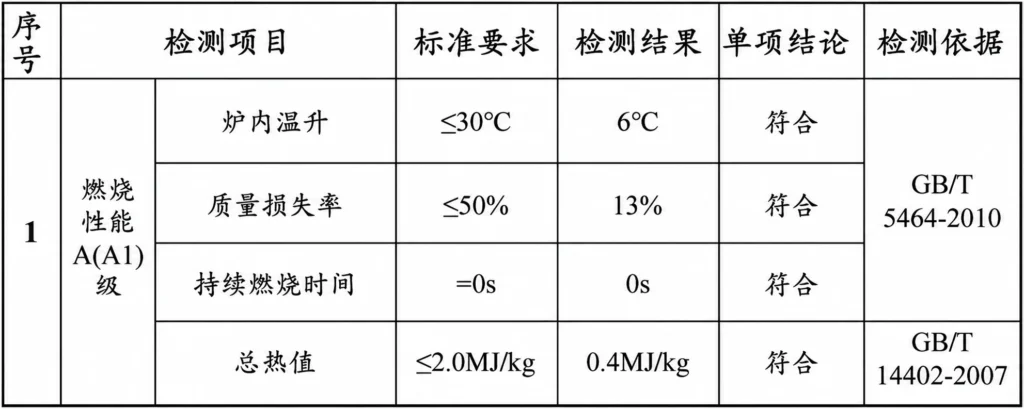
The main test results include:
| Test Item | Requirement | Test Result | Conclusion |
|---|---|---|---|
| Furnace temperature rise | ≤30°C | 6°C | Pass |
| Mass loss rate | ≤50% | 13% | Pass |
| Sustained flaming time | 0 s | 0 s | Pass |
| Gross calorific value | ≤2.0 MJ/kg | 0.4 MJ/kg | Pass |
The results show that the tested sample met the specified requirements for the fire-performance items listed in the report.
For project specification, the classification should always be considered together with the corresponding test method and the actual product being supplied.
Fire-Resistant Wall Panels Do Not Mean the Entire Wall System Is Fire Rated
When searching for wall finishes, buyers often come across terms such as:
Fire Resistant Wall Panels
Fire Rated Wall Panels
Fireproof Wall Panels
These terms are commonly used to describe materials with certain fire-performance characteristics. However, the performance of a decorative panel does not automatically represent the performance of the complete wall system.
Flexible stone is typically used as a lightweight decorative wall panel or cladding finish.
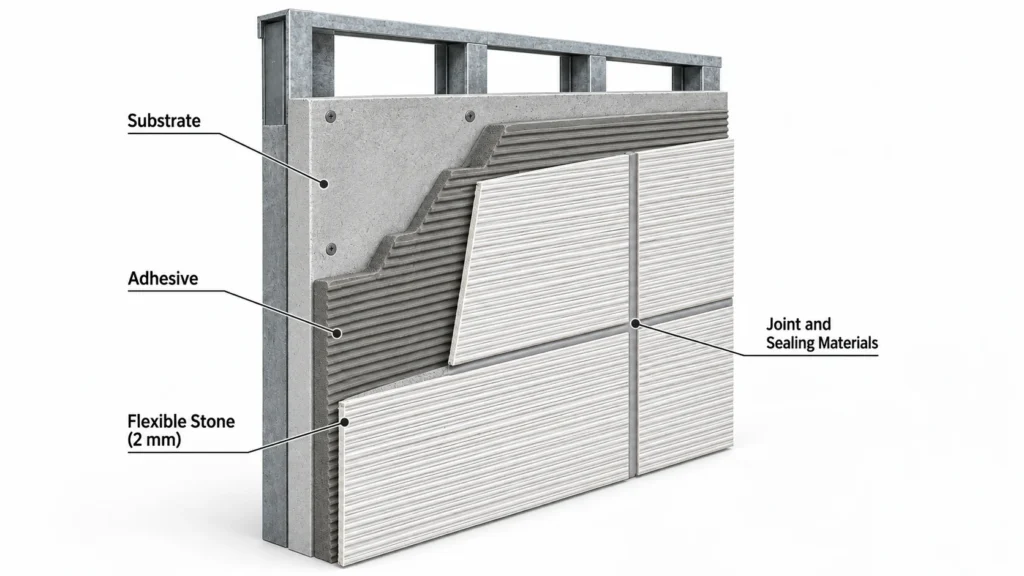
A complete installation system involves multiple components, not just the surface material.
For projects with specific fire-safety requirements, both the surface material and the overall installation system should therefore be reviewed.
Do the Adhesive and Substrate Matter?
Yes.
Flexible stone can be installed over suitable substrates such as cement-based surfaces, concrete, magnesium oxide board, metal panels, existing ceramic tiles and other stable bases.
Different substrates, adhesives and installation methods can create different system configurations. It should therefore not be assumed that every installation combination will have exactly the same fire-performance characteristics.
For hotels, commercial buildings and public spaces, it is better to consider:
surface material test documentation + substrate system + adhesive + installation method + project requirements
This is particularly important where the complete wall construction is subject to specific building or fire-safety requirements.
Where Are Fire-Resistant Wall Panels Commonly Considered?

Fire performance is often reviewed more closely in projects such as:
- hotels
- shopping centers
- office buildings
- public spaces
- apartment common areas
- commercial interiors
- selected exterior wall applications
For these projects, architects, contractors and buyers are more likely to request formal test documentation and actual performance data rather than relying only on a “Fire Resistant” statement on a product page.
What Should Buyers Check in a Flexible Stone Fire Test Report?
Instead of asking only, “What fire rating does this product have?”, it is more useful to review the following information.
1. Which Product Was Tested?
Check whether the tested product matches the material being specified or purchased.
Important details may include:
- product construction
- thickness
- backing
- surface type
- other relevant product specifications
If the construction changes significantly, the existing test result should not automatically be assumed to apply in exactly the same way.
2. Which Test Standard Was Used?
Different markets may use different test methods and classification systems.
A fire rating should therefore be reviewed together with the corresponding test method, rather than comparing classification names alone.
3. Is the Report Complete and Traceable?
For formal projects, buyers should also check:
- testing laboratory
- report number
- product identification
- test method
- complete test results
A complete fire test report provides more useful verification than a single fire-rating claim.
4. What Does the Project Require?
Final suitability should also be considered in relation to the:
building type + application area + local requirements + project specification
This becomes especially important for international projects, where local codes and certification requirements may differ.
Does a Class A Fire Rating Mean the Material Cannot Burn?
Not necessarily.
A fire-performance classification is based on defined test methods and evaluation criteria. It does not mean that a material is completely unaffected under every possible fire condition.
For this reason, absolute statements such as:
“100% Fireproof”
can be misleading.
A more useful and professional way to describe fire performance is to provide:
test classification + test method + actual test data
This gives architects, contractors and project buyers more practical information for material evaluation.
Can Flexible Stone Be Used as Fire-Resistant Wall Cladding?

For projects that require a balance of low weight, decorative appearance and documented fire performance, flexible stone can be a practical wall finish or cladding option.
For wall and cladding applications, key features include:
- relatively thin construction
- lower wall loading than many conventional stone finishes
- easy on-site cutting
- a wide range of textures and surface effects
- large-format panel options
- suitability for both interior and selected exterior applications
Where a specific fire rating, test standard or certification is required, product selection should consider both the desired appearance and the relevant technical documentation.
What Fire-Performance Documentation Can YITA Provide?
YITA can provide available fire-performance test documentation for relevant products to support material selection and technical review.
For projects with specific fire requirements, the applicable documentation should be confirmed according to the selected product, intended application and required standard.
Where additional testing is required, YITA can assist with arranging appropriate third-party testing. The testing scope, cost and lead time will depend on the project requirements.rements.
What Information Should You Provide for a Project with Fire Requirements?
If your project already has a specific fire-performance requirement, it is helpful to provide this information during the material-selection or quotation stage:
project location → interior or exterior application → project type → selected texture → required size and thickness → required fire standard or certification
This makes it easier to determine whether the available technical documentation is suitable and whether additional third-party testing may be required.
Confirming these requirements early can also help avoid unnecessary changes later in the specification process.
Conclusion
The fire performance of flexible stone should not be judged only by general terms such as “fire resistant” or “fireproof.”
For building projects, it is more useful to review the actual technical information behind the product:
test method → test results → product construction → installation system → project requirements
Fire requirements may vary by application and market, so the relevant documentation should always be reviewed before final material selection.