
-
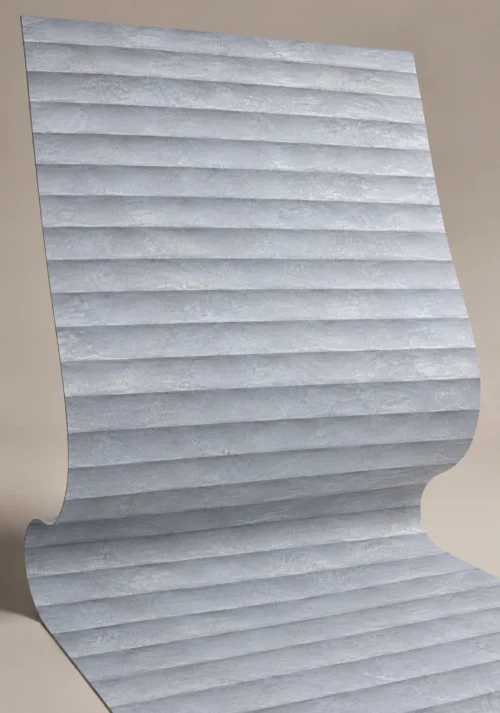
Stone Metal Harmony
$35.00 -
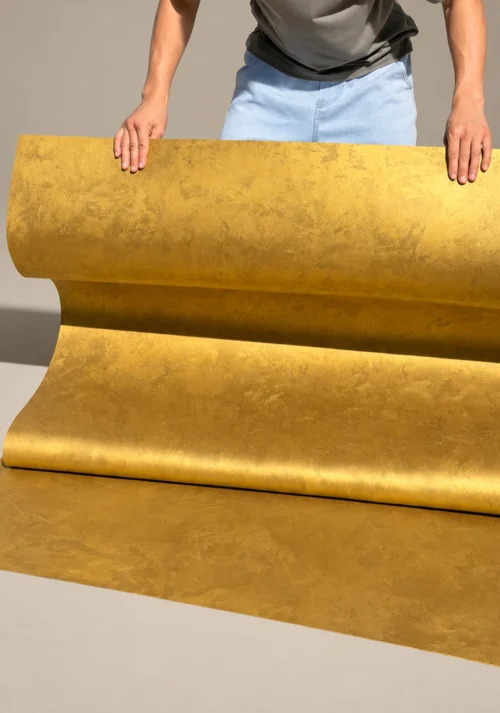
Metallic Silk
$35.00

-
Call Now 578-393-4937
-
Any Questions cosmetics@mail.com
Rammed Earth Veneer
MCM Flexible Tile
Layered Earth, Natural Character.
Rammed Earth Veneer recreates the layered tones, granular texture, and earthy character of traditional rammed earth in a lightweight architectural finish. As an MCM Flexible Tile, it combines a natural earthen appearance with flexible handling for contemporary interior and exterior surfaces.
From texture selection and sample review to production and delivery, we support projects with practical material guidance and responsive sourcing. Whether for a single feature wall or a larger architectural scheme, our team helps coordinate specifications, finishes, quantities, and project requirements.
Rammed Earth Collection & Products
Explore rammed earth-inspired surfaces with varied strata, earthy tones, and mineral textures. From subtle layered finishes to richer earthen expressions, each design brings a warm, tactile character to architectural walls.
Features & Selection Considerations
Advantages
- Authentic Earthen Character
Layered strata, granular textures, and natural earth tones recreate the visual depth of traditional rammed earth walls. - Rich Tonal Variation
Beige, sand, terracotta, brown, and grey tones provide different interpretations of an earthy architectural palette. - Lightweight & Flexible Format
The thin flexible format is easier to handle and can adapt to walls, columns, and selected curved surfaces. - Fire, Water & Moisture Performance
Inorganic material characteristics provide fire performance together with resistance to water and moisture, supporting demanding architectural applications. - Versatile for Interior, Exterior & Commercial Spaces
Suitable for interior and exterior walls, feature surfaces, hospitality, residential, and commercial architectural projects.
Important
- Review Samples Before Selection
Earthen tones and layered textures may vary slightly between colors and production batches. Samples should be reviewed before final selection. - Consider Layer Direction
The direction and continuity of the rammed earth texture can significantly influence the overall appearance of a wall. - Coordinate Colors with Surrounding Materials
Earth tones work particularly well with timber, concrete, stone, metal, and other natural finishes. - Plan Large-Surface Layouts Carefully
For larger projects, confirm panel dimensions, texture direction, color selection, and installation sequence before production. - Confirm Application Requirements
Select the appropriate finish according to the substrate, environment, and intended interior or exterior application.
Technical Specifications Table
General Specifications
| Specification | 600 × 1200 mm/1200 × 2400 mm/other |
| Raised Thickness | 2–4 mm |
| Weight per Square Meter | 4.1–4.5 kg |
| Water Absorption | 7.50% |
| Artificial Weathering | 2,000 h |
| TVOC | 6.2 g/m² |
| Dimensional Tolerance | ±1 mm |
| Negative Ion Concentration | 2.7 × 10⁴ ions/cm³ |
| Internal Exposure Index (Ir) | 0.1 |
Composition & information on ingredients
| Substance name | Conc. (%) | CAS. |
| Silicon dioxide | 76.69 | 7631-86-9 |
| Calcium oxide | 11.14 | 1305-78-8 |
| Acrylic polymer | 4.9 | / |
| Aluminium oxide | 4.5 | 1344-28-1 |
| Magnesium oxide | 2.06 | 1309-48-4 |
| Manganese monoxide | 0.22 | 1344-43-0 |
| Iron oxide | 0.22 | 1332-37-2 |
| Titanium dioxide | 0.2 | 13463-67-7 |
| Hydroxyethyl methyl cellulose | 0.07 | 9032-42-2 |
Fire Performance Class A (A2-s1, d0)
| No. | Test Item | Standard Requirement | Test Result | Conclusion | Test Standard |
| 1 | Total Heat Release (THR) | ≤ 3.0 MJ/kg | 0.7 MJ/kg | Pass | GB/T 14402-2007 |
| 2 | Fire Growth Rate Index (FIGRA₀.₂MJ) | ≤ 120 W/s | 31 W/s | Pass | GB/T 20284-2006 |
| 3 | Total Heat Release within 600 s (THR₆₀₀s) | ≤ 7.5 MJ | 1.0 MJ | Pass | GB/T 20284-2006 |
| 4 | Lateral Flame Spread | Not reaching the edge of the long wing of the specimen | Not reaching the edge of the long wing of the specimen | Pass | GB/T 20284-2006 |
| 5 | Smoke Growth Rate Index (SMOGRA) | ≤ 30 m²/s² | 0 m²/s² | Pass | GB/T 20284-2006 |
| 6 | Total Smoke Production within 600 s (TSP₆₀₀s) | ≤ 50 m² | 38 m² | Pass | GB/T 20284-2006 |
| 7 | Flaming Droplets/Particles | No flaming droplets/particles within 600 s | No flaming droplets/particles within 600 s | Pass | GB/T 20284-2006 |
Environmental & Material Safety
| No. | Test Category | Test Item | Standard Requirement (Indoor) | Test Result | Conclusion | Test Standard |
| 1 | Hazardous Substance Limits | TVOC (g/m²) | ≤ 10 | 6.2 | Pass | GB 18586-2001 5.5 |
| 2 | Hazardous Substance Limits | Soluble Lead (mg/m²) | ≤ 20 | Not Detected | Pass | GB 18586-2001 5.4 |
| 3 | Hazardous Substance Limits | Soluble Cadmium (mg/m²) | ≤ 20 | Not Detected | Pass | GB 18586-2001 5.4 |
| 4 | Radionuclide Limits | IRa | ≤ 1.0 | 0.0⁺ | Pass | GB 6566-2010 |
| 5 | Radionuclide Limits | Ir | ≤ 1.3 | 0.0⁺ | Pass | GB 6566-2010 |
Need Help Choosing the Right Rammed Earth Veneer MCM Flexible Tile?
Tell us about your project and application, and our team will recommend suitable flexible stone veneer solutions for your needs.
Project Applications
Rammed earth textures bring warmth and natural depth to residential interiors, hospitality spaces, commercial walls, and exterior architectural surfaces. As an MCM Flexible Tile, this lightweight finish works particularly well for feature walls, entrance areas, façades, and spaces designed around natural and contemporary materials.
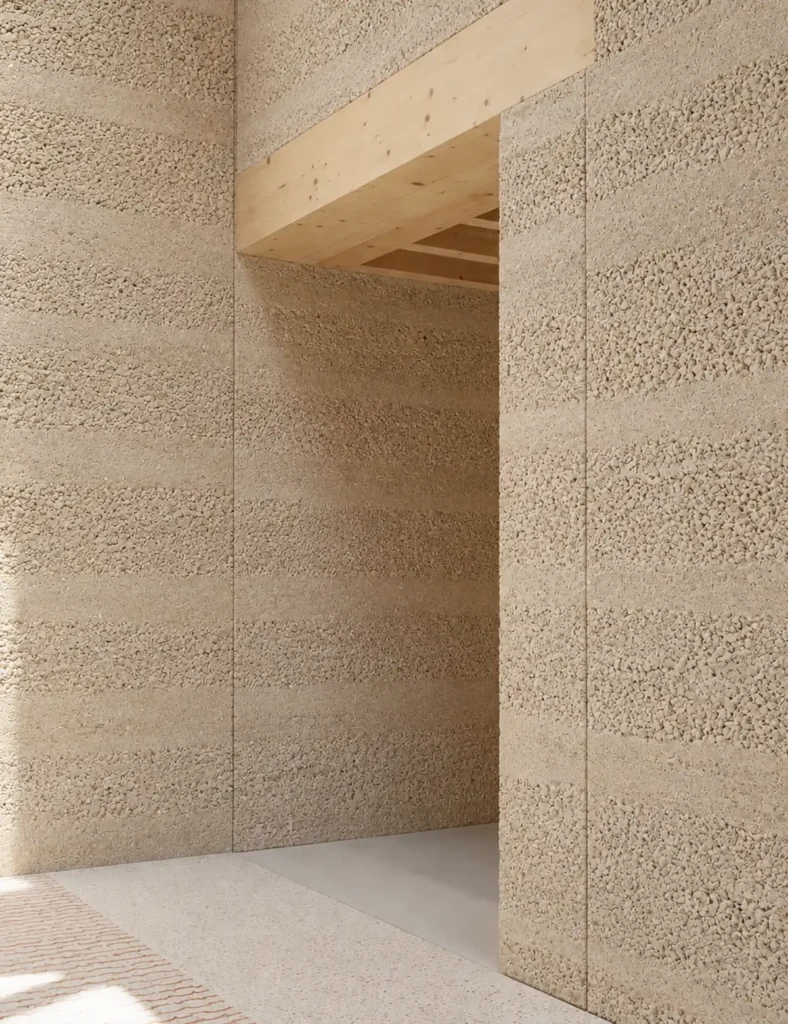
Light beige rammed earth veneer adds subtle mineral texture and warm architectural character to this clean, timber-accented interior.
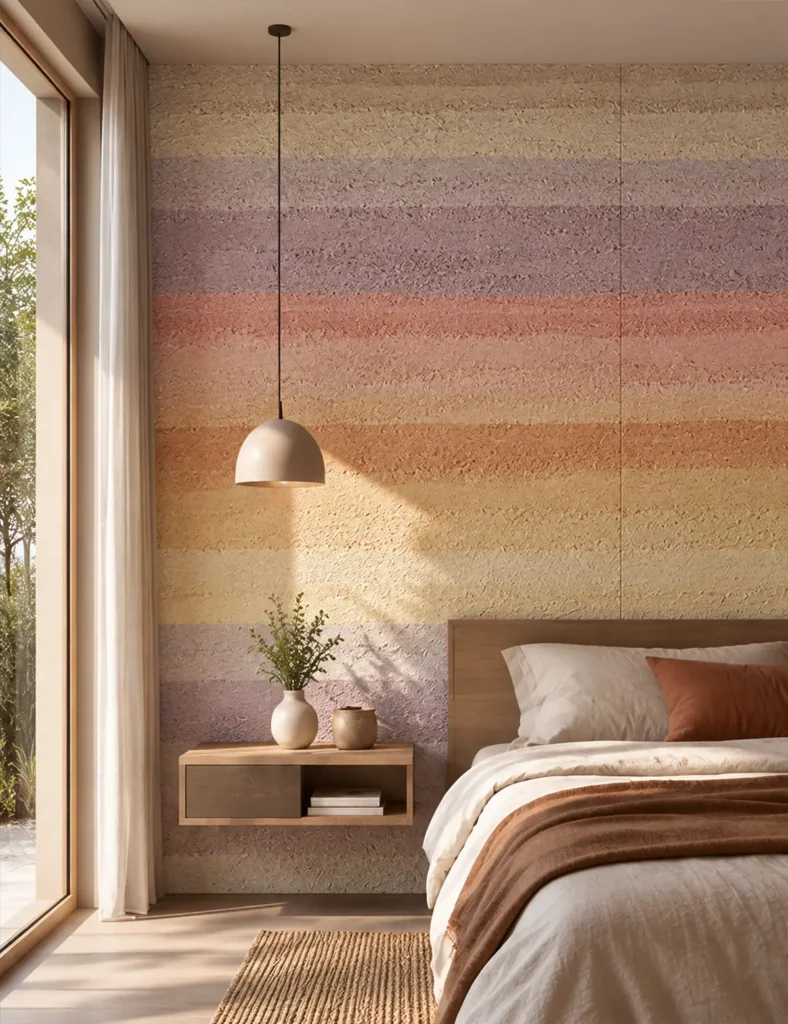
Layered earth tones and tactile mineral texture turn the bedroom wall into a warm, distinctive architectural feature.
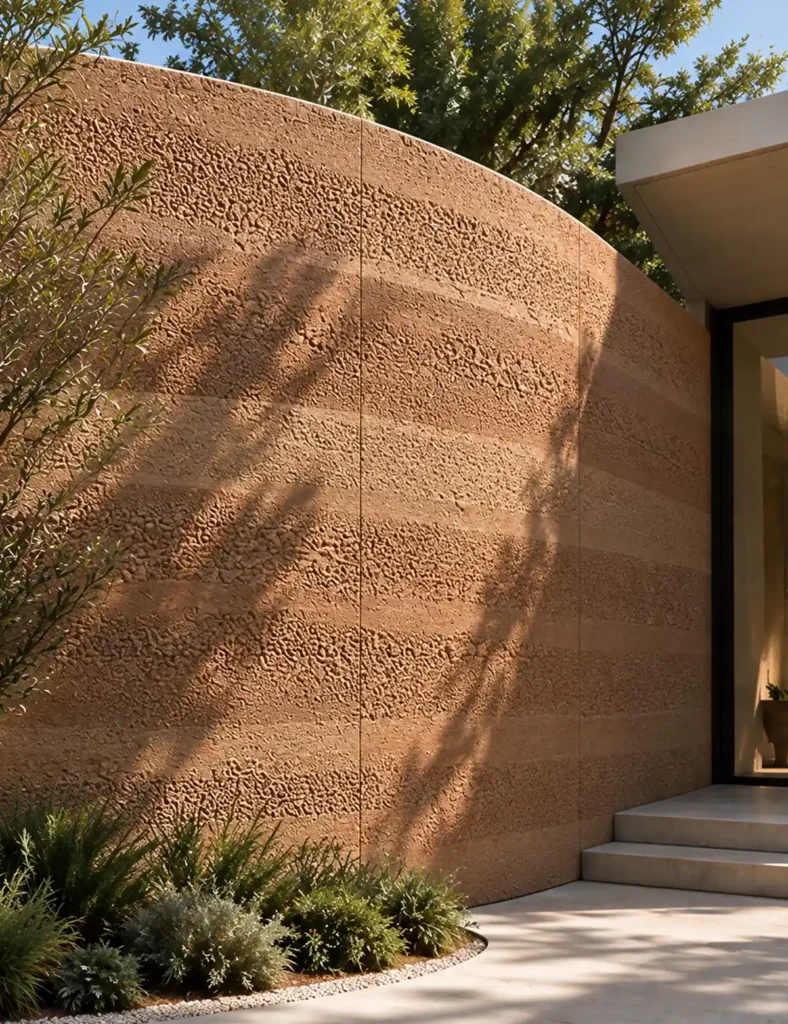
Rammed earth veneer follows the curved facade with layered mineral texture, creating a warm connection between modern architecture and the surrounding landscape.
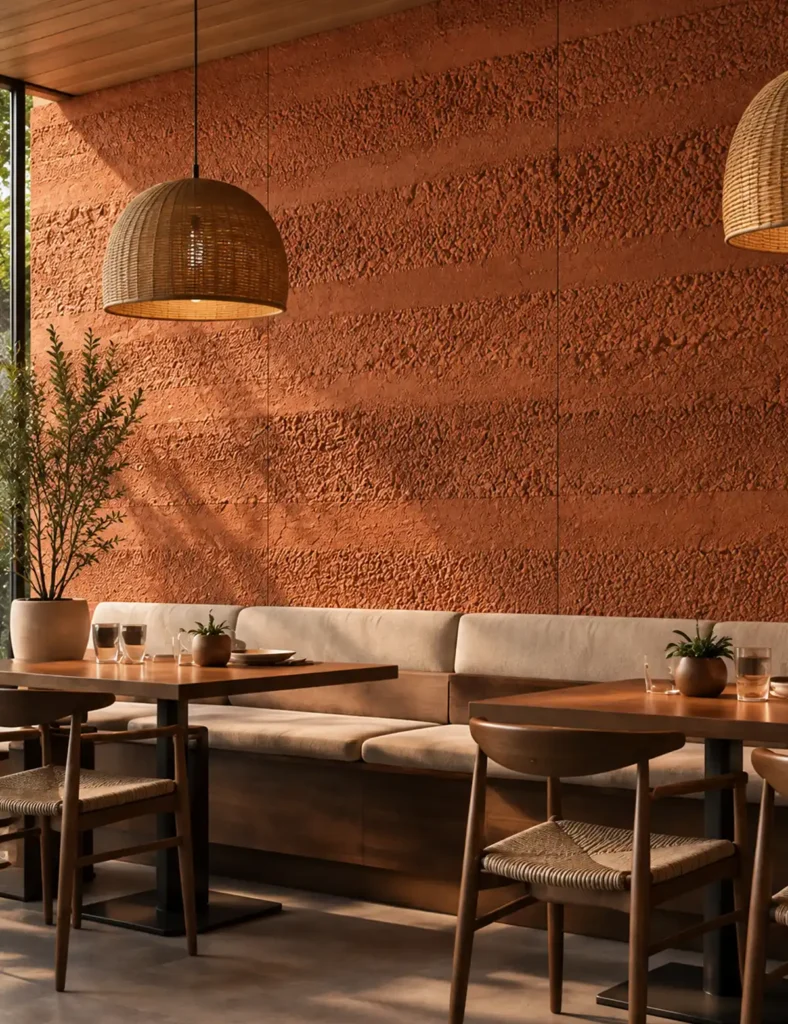
Terracotta mineral tones give the dining space a warm, grounded character while adding visual depth behind the natural timber furnishings.
Installation
Get practical guidance for achieving a consistent rammed earth finish from surface preparation to final installation. Our resources cover panel handling, cutting, adhesive application, texture direction, and layout planning for different architectural surfaces.
Rammed Earth Veneer Installation Guide
Learn how to prepare surfaces, handle panels, apply adhesive, and align layered textures for a natural, consistent finish.
Technical Support for Projects
Get guidance on texture selection, color coordination, adhesive compatibility, layout planning, and project-specific installation requirements.
Customer Feedback & Application Considerations
Hear from designers, contractors, and project teams who have explored rammed earth textures for residential, hospitality, and commercial applications.
“The layered earth texture gives the wall a much warmer and more natural feel than a standard painted finish. It works especially well with timber and soft lighting.”
“The texture direction was important for getting a continuous look across the wall. Once the layout was planned, the panels were straightforward to handle and install.”
“We wanted the character of rammed earth without the weight and construction complexity of a traditional wall. The flexible format gave us more freedom during the design stage.”
“The different earth tones gave us more flexibility when matching the material with concrete, timber, and other natural finishes. Reviewing samples beforehand was very helpful.”
Bubbling, Hollow Spots & Surface Detachment
Potential Issue:
Insufficient adhesive coverage, trapped air, excessive substrate moisture, or installation on an unstable surface can lead to bubbling, hollow areas, edge lifting, and panel separation.
Key Precaution:
Avoid spot bonding. Check the substrate and adhesive compatibility on a small test area before large-scale installation, especially for exterior or moisture-prone applications.
Cracking, Edge Lifting & Joint Failure
Potential Issue:
Substrate movement, uneven surfaces, improper bending, or inadequate treatment of joints and edges may cause visible stress, cracking, curling, or separation around corners and panel joints.
Key Precaution:
For curved walls and architectural details, gradually form the flexible stone veneer instead of applying excessive localized pressure. Plan panel layout and joint positions before installation.
Staining, Texture Inconsistency & Uneven Finish
Potential Issue:
Incorrect adhesive, excessive adhesive thickness, uneven pressure, or improper panel layout can cause visible adhesive marks, surface irregularities, or inconsistent texture flow.
Key Precaution:
Always evaluate physical samples before installation. For large projects, confirm texture, color, batch consistency, panel orientation, and overall layout before production and installation.
Global Shipping Support
Reliable export packing and logistics coordination for overseas projects and wholesale orders.
Project-Based Solutions
Material options, dimensions and surface finishes selected around the needs of each project.
Technical Support
Application advice and installation guidance to support smoother project execution.
Quality Assurance
Consistent material standards and careful inspection help deliver dependable surface quality.