
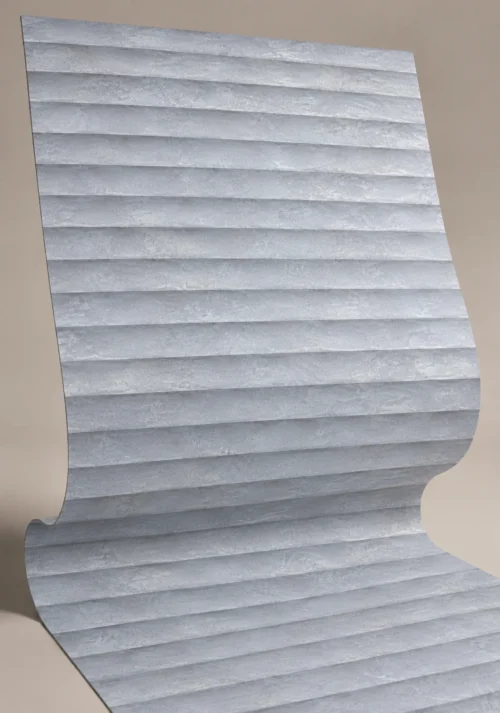
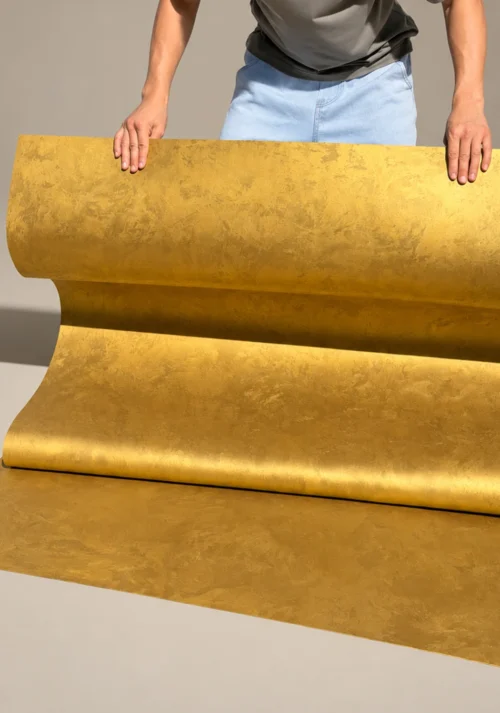

-
Call Now +86 13693186054
-
Any Questions info@yitaflexstone.com
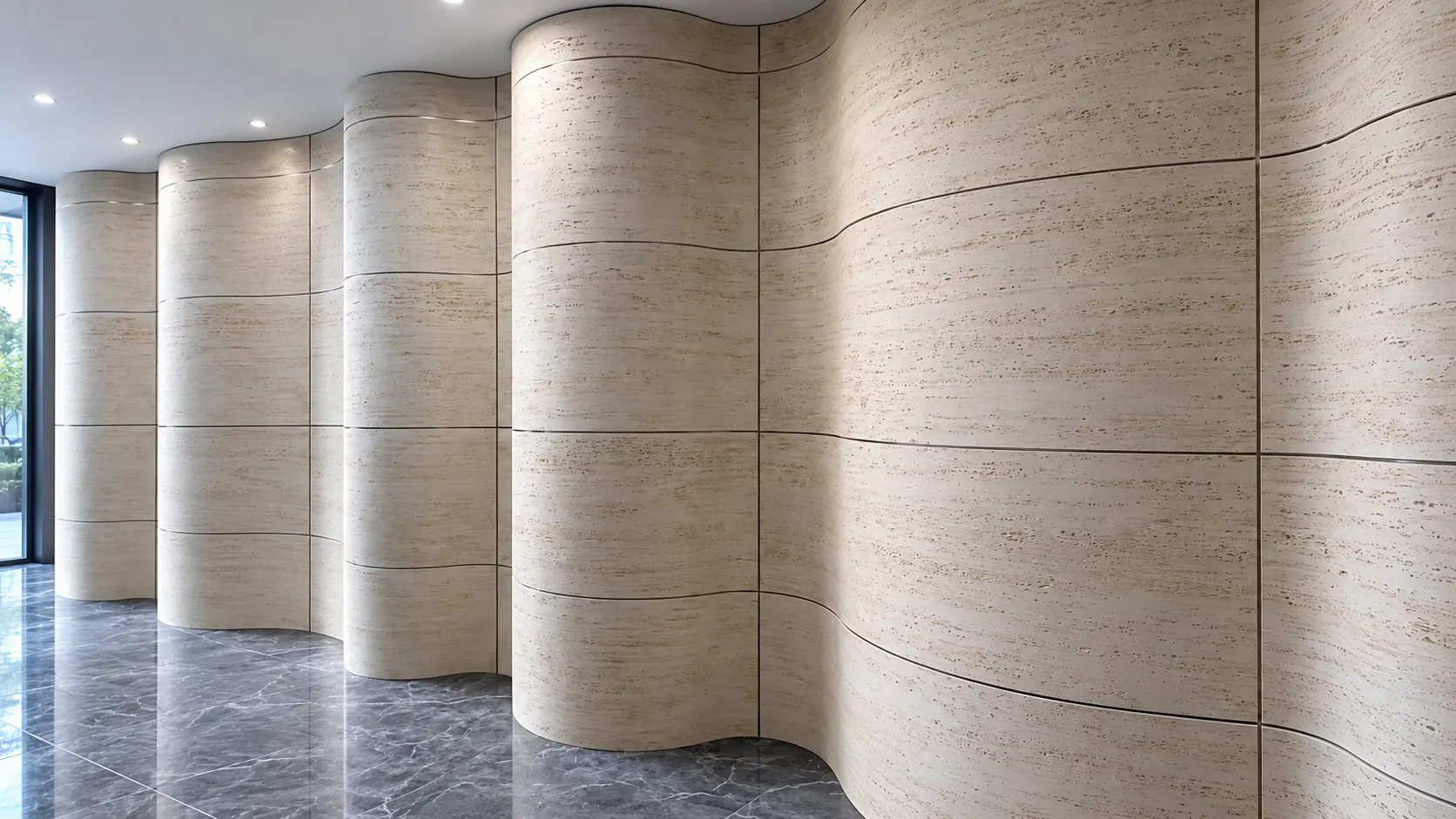
Can MCM flexible stone be used on curved walls?

Yes — MCM flexible stone can be used on curved walls, and it is one of the most practical cladding materials for columns, arches, curved feature walls and rounded corners. Because MCM is lightweight, thin and inherently flexible, it bends to follow curved substrates that rigid natural stone and ceramic tiles simply cannot handle. Architects and interior designers increasingly specify MCM precisely because it turns a difficult curved detail into a clean, continuous stone finish.
What Is MCM Flexible Stone?
MCM stands for Modified Clay Material, also known as soft porcelain or flexible imitation-stone facing material. It is made from natural inorganic mineral powders combined with high-performance polymers, then pressed and moulded into thin sheets that faithfully reproduce the texture, grain and colour of natural stone. The result looks like real stone but behaves like a flexible membrane.
Compared with Traditional Cladding & Determines its flexible properties
- Lightweight: a typical surface density of only about 3–6 kg per square metre, far lighter than natural stone slabs (which often exceed 20–40 kg per square metre depending on thickness).
- Thin: standard sheets range from about 2 mm to 6 mm thick, adding almost no structural load.
- Flexible: the sheet can be cold-bent to follow curved substrates without cracking or delamination, which is the key advantage for curved work.
Learn More About MCM Flexible Stone
Why Traditional Stone Fails on Curves?
Natural stone and rigid ceramic tiles are hard and essentially non-bendable. On a curved wall, installers must cut the material into many small pieces and piece them together. This creates numerous joints and weak points, a slow and expensive installation, and an inconsistent visual result. Thick stone slabs also need complex structural supports, and any thermal movement or substrate movement can crack the rigid cladding.
MCM flexible stone solves this problem at its root: because the sheet itself bends, a single piece can wrap around a column, arch or curved wall with far fewer joints. The difference is most visible on columns and arches: a rigid material requires dozens of narrow cut pieces that show as a patchwork, while MCM wraps the whole curve in a smooth, continuous sheet.
| Property | MCM Flexible Stone | Natural Stone Slab | Ceramic / Rigid Tile |
|---|---|---|---|
| Bendability | Cold-bends around curves | None — rigid | None — rigid |
| Min. Radius (Typical) | R 20–300 mm by thickness | N/A | N/A |
| Weight | 3–6 kg/m² | 20–40+ kg/m² | 8–20 kg/m² |
| Curved Installation | Wrap in one piece, few joints | Cut & piece, many joints | Cut & piece, many joints |
| Cracking Risk on Curves | Low (correct installation) | High | High |
| Cost on Curves | Lower, faster | High, slow | Medium, slow |
How much can MCM flexible stone bend?
The bending performance of MCM flexible stone is defined by its minimum bending radius — the smallest curve the sheet can follow before cracking. This depends mainly on sheet thickness and, to a lesser extent, on the specific formulation.
In China, MCM flexible stone is governed by two industry standards. JG/T 311 (Flexible Facing Brick) defines the flexibility test and minimum bending performance, and JG/T 540-2017 (Flexible Decorative Material of Imitation Stone for Building) sets out classification, requirements and testing methods. These standards give engineers and specifiers a reliable baseline for evaluating curved cladding applications.
According to the industry standard JG/T 311, a standard MCM sheet must pass a bending test around a 200 mm diameter cylinder without cracks, which means a minimum bending radius of about 100 mm (R100). Thinner grades perform even better: 2–3 mm ultra-thin sheets can be cold-bent to a radius of roughly 20–50 mm. For very tight curves, gently warming the panel increases flexibility even further.
Key notes:
- Thinner sheets bend tighter; thicker 4–5mm MCM needs larger radius (R≥100mm).
- Cold bending at ambient temperature, no heat required for most curved column & curved wall jobs.
- Bending performance is for one-time installation forming; repeated heavy bending is not recommended.
- Ideal for wrapping cylindrical columns, curved feature walls, arches, rounded corners for interior decoration and building facade renovation.
- Always test sample panels on-site before full construction.
Minimum bending radius by sheet thickness (conservative values)
| Sheet Thickness | Minimum Radius (Typical) | Best Use |
|---|---|---|
| 2–3 mm (ultra-thin) | R 20–50 mm | Interior curved walls, tight columns |
| 3 mm | R 150–200 mm | Columns, curved feature walls |
| 4–5 mm (standard) | R 300 mm | General curved walls, facades |
| 6 mm (heavy) | Larger radius required | Large-radius exterior curves |
Two practical notes are worth remembering. First, bending is a one-time forming process, so avoid repeatedly folding a sheet back and forth — it is not a rubber sheet designed for repeated flexing. Second, the values above are conservative; always request an on-site sample test on your actual substrate before full-scale installation, because the real radius you can achieve also depends on corner geometry and joint width.
Curved Surfaces You Can Achieve
Because of its flexibility, MCM can clad almost any curved geometry that a stable substrate can provide. Typical applications include:
- Round and oval columns for lobbies, reception areas and entrances.
- Arches and arched doorways in hotels, retail and residential interiors.
- Domes, barrel vaults and curved ceiling soffits.
- Curved feature walls, curved brand walls and wave-form facades.
- Rounded corners, eased edges and transition zones between wall planes.
- Curved window reveals, bay windows and staircase walls.
Because the substrate must carry the finished stone look, the curved frame can be built from plasterboard, cement-rendered masonry, metal lath or curved plywood, depending on the radius and load. MCM simply follows the shape, so the design freedom comes from the substrate you build, not from the limitations of the cladding.
Step-by-Step Installation on Curved Walls
Correct installation is the key to a crack-free curved cladding. Follow these steps, and keep a small checklist with the project:
- Step 1 — Prepare the substrate. The curved substrate must be solid, clean, level and free of dust or oil. Apply a suitable primer to loose or porous surfaces before tiling.
- Step 2 — Choose the right adhesive. Use a C2S1 flexible tile adhesive (cement-based, enhanced performance and flexible grade). Its S1 flexibility absorbs thermal movement and micro-deformation so the thin MCM sheet does not de-bond or crack.
- Step 3 — Apply adhesive to both surfaces. Butter-coat both the wall and the back of the MCM sheet with a notched trowel to guarantee full coverage on a curve; double buttering is essential on curved geometry where point contact is easy.
- Step 4 — Install from top to bottom. Working downwards lets any squeezed-out wet adhesive fall onto the unfinished substrate instead of staining already-installed panels, and avoids disturbing freshly bonded sheets before the adhesive cures.
- Step 5 — Press, level and remove excess. Gently press and rub each panel to expel air and excess adhesive; clean squeeze-out from panel edges immediately before it dries.
- Step 6 — Leave expansion joints of 2–3 mm between panels, then grout after the adhesive sets.
- Step 7 — Cure. Allow at least 24 hours before any loading and a full 7 days to reach design strength. Do not knock or pull panels during this period.
On tight radii, pre-scoring the back of the sheet along the bend line with a sharp cutter can help it follow the curve more easily; on large-radius curves this is usually unnecessary. Always work from a plumb line and check each panel with a straightedge so the joints stay aligned around the curve.
Detailed Installation Guide
Installing Flexible Stone on Curved Surfaces: Substrate and Adhesive Requirements
MCM flexible stone bonds reliably to a wide range of substrates: concrete, cement-sand render, existing ceramic tiles, plasterboard and heated floor systems, provided the base is sound and properly primed. Loose, sandy or oily substrates must be treated first, because a weak base is the most common cause of later hollowing and peeling regardless of the adhesive used.
For curved work, the C2S1 flexible adhesive is recommended. The “C2” grade delivers an enhanced tensile bond strength of at least 1.0 MPa, while the “S1” flexibility rating (transverse deformation of 2.5–5 mm) absorbs the movement of both the substrate and the thin stone sheet. Apply it with a thin-bed technique — roughly 2–3 mm — using double buttering for best contact on curves. Avoid ordinary rigid mortar or cheap C1 adhesive on curved installations, as they lack the flexibility to absorb movement without delamination.
Selecting Flexible Adhesive Mortar
Real Applications and Case Examples
MCM flexible stone is widely used on curved surfaces in various types of buildings, such as hotels, restaurants, storefronts, building renovations, exterior walls, and residential properties.
Hotels
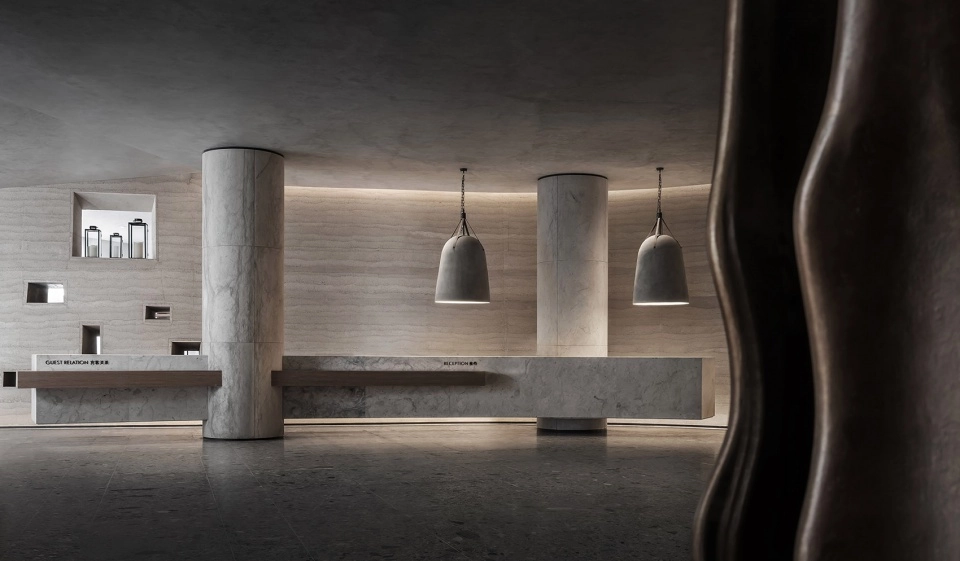
Curved lobby feature walls, round columns and arched brand walls that create a premium stone look and a memorable first impression.
Retail and F&B

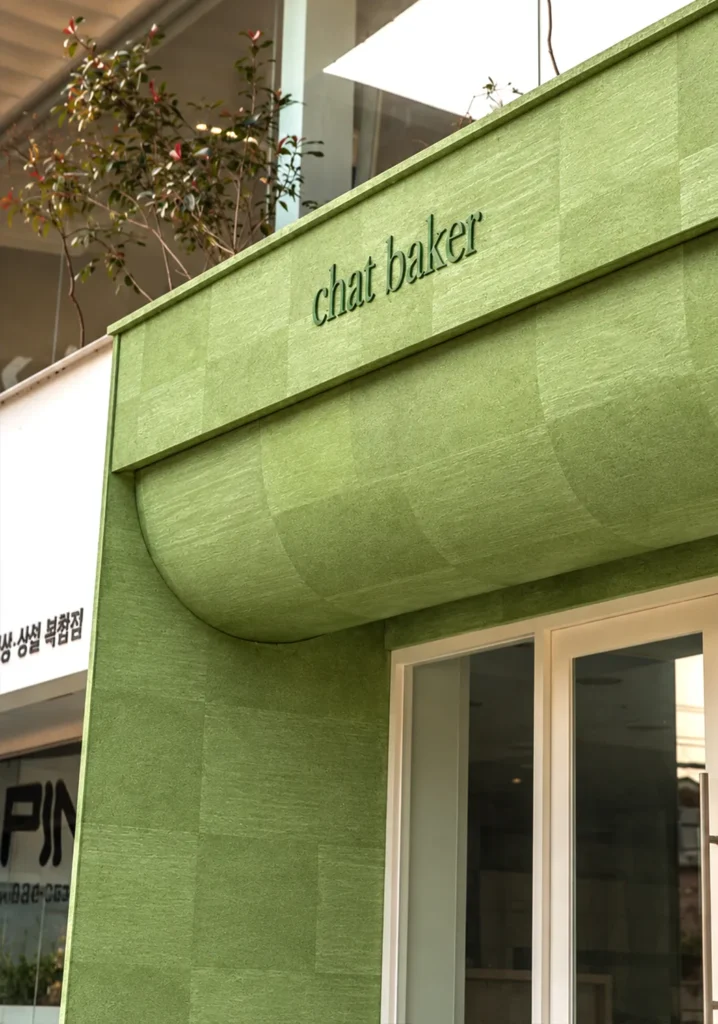
Curved counters, bar fronts and wave-form brand walls in shops, cafés and restaurants, where a continuous stone finish strengthens the brand image.
Renovation
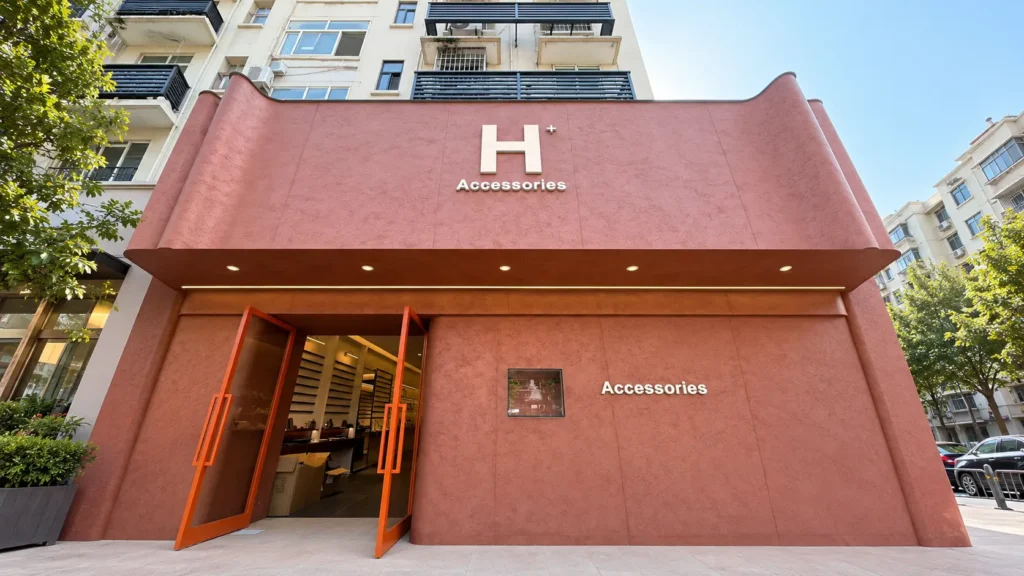
Re-cladding old curved walls and curved facades quickly, with far less demolition than replacing rigid cladding, which is why MCM is popular in old-building facade renewal.
Exteriors
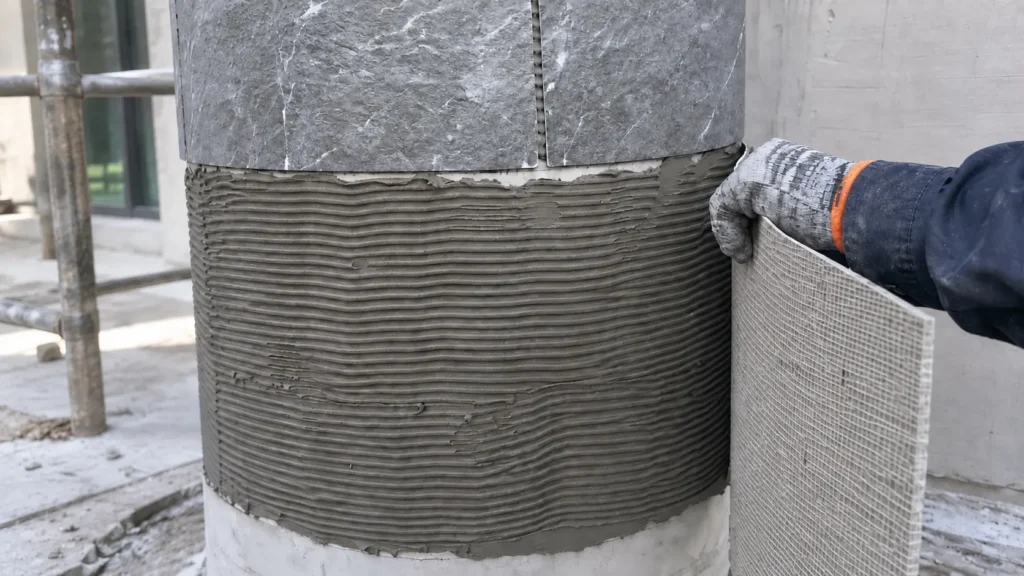
Curved building envelopes, domes and arched entrances where a continuous stone finish is required and lightweight cladding keeps structural loads low.
Residential
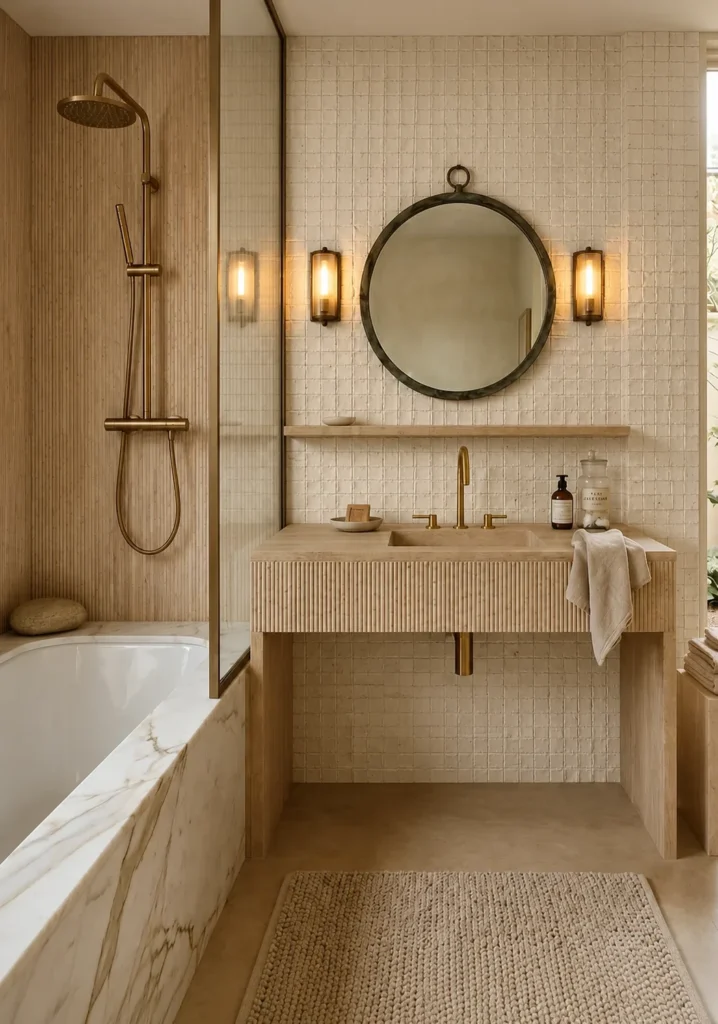
Curved accent walls, rounded alcoves and wet-area facings in kitchens and bathrooms, giving homes a stone look without the weight of stone.
More Detailed Case Studies
In every case the pattern is the same: a stable curved substrate, a C2S1 flexible adhesive, and careful top-down installation produce a durable, seamless curved stone finish at a fraction of the cost and time of rigid materials.
“For YITA Flexible Stone, product selection can be matched to the intended surface, texture, bending requirement and interior or exterior application. For demanding projects, samples and technical documentation should be reviewed before final specification.”
Common Mistakes to Avoid
- Using rigid mortar or a non-flexible adhesive — this is the fastest route to cracking and hollowing on a curve.
- Installing from bottom to top — squeezed-out wet adhesive drips onto finished panels and stains the porous stone surface.
- Over-flexing a sheet back and forth — MCM is a one-time-forming material, not a rubber sheet.
- Skipping the on-site bend test — real results depend on your substrate and corner geometry.
- Neglecting expansion joints — even flexible stone needs 2–3 mm joints to handle movement.
- Loading panels before the adhesive cures — knock or pull within 24 hours and you risk de-bonding.
FAQ
Will mcm flexible stone crack on curves?
No — with correct installation. Standard sheets pass a 200 mm diameter bending test (JG/T 311), so they reliably follow normal curved walls and columns without cracking.
Does MCM flexible stone need to be heated before installation on curved walls?
Usually not. Most curves are achieved by cold bending. For very tight radii, gentle warming increases flexibility.
Can a bent sheet be flattened again?
No, bending is a one-time forming process; plan the curve before installation.
Can MCM flexible stone be used outdoors?
Yes. MCM flexible stone is weather-resistant and suitable for curved exterior facades, with appropriate adhesive and sealing.
What is the smallest radius?
Based on test data and measurements from actual application cases, the radius of curvature for standard YITA panels is approximately R100 millimeters; for ultra-thin (2–3 millimeters) panels, the radius of curvature can reach R20–50 millimeters.
Conclusion
MCM flexible stone can absolutely be used on curved walls, and it is one of the most efficient ways to achieve a continuous stone finish on columns, arches, curved walls and rounded corners. The keys to success are a sound, primed substrate, a C2S1 flexible adhesive, top-down installation with double buttering, proper expansion joints and adequate curing. Choose the right sheet thickness for your radius, and always test on your actual substrate before full-scale installation.
For projects that demand curved stone cladding, MCM flexible stone delivers the natural look of stone with the flexibility and light weight that make curved architecture practical and affordable. If you are planning a curved wall, column or arch, MCM is very likely the right material — spec it with the correct adhesive and installation method, and you can expect a clean, durable, premium result.