
-
Stone Metal Harmony
$35.00 -

Metallic Silk
$35.00

-
Call Now 578-393-4937
-
Any Questions cosmetics@mail.com
Can Flexible Stone Be Used Outdoors? An Exterior Wall Guide
Bychloe
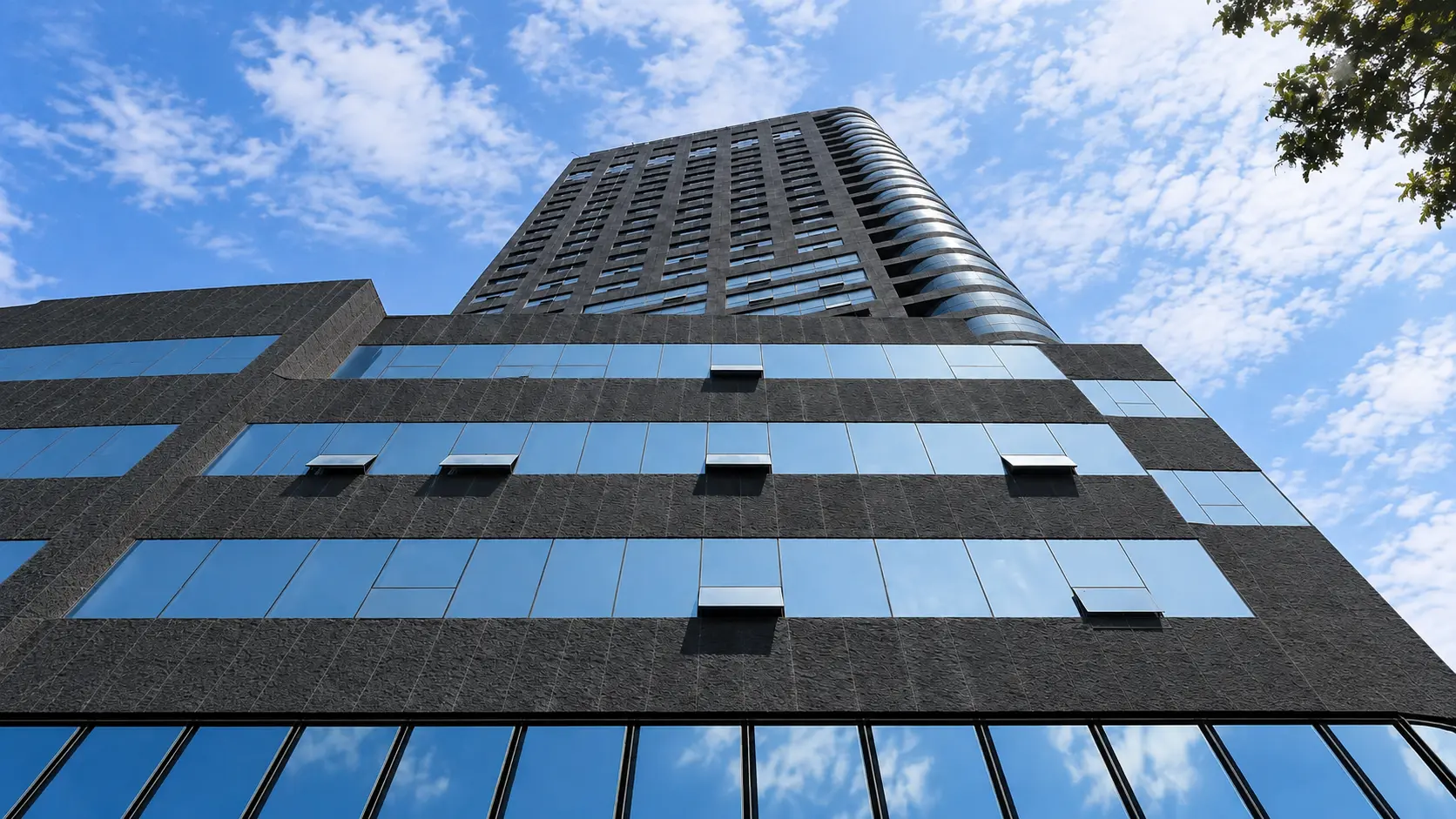
Yes. Flexible stone can be used on exterior walls, but long-term performance depends on both the material itself and how well the complete wall system is designed and installed.
For outdoor applications, product performance is only one part of the picture. Climate, substrate condition, adhesive selection, joint detailing, water management and workmanship all influence how the finished wall performs over time.
YITA flexible stone products have undergone 2,000 hours of artificial weathering testing, along with freeze-thaw, water absorption, heat resistance and flexibility testing.
These tests provide useful performance data for exterior applications, but laboratory results cannot replace an assessment of the actual building environment.
So the question is not simply whether flexible stone can be used outdoors. The more useful question is:
Is this material suitable for this building and the conditions it will actually face
Start With the Building, Not the Material
The same exterior finish can face very different conditions in Singapore, Dubai and Canada.
Singapore brings heat, humidity and frequent rain. Dubai brings stronger solar exposure and high temperatures. In parts of Canada, low temperatures and repeated freeze-thaw cycles may also need to be considered.
Even on the same building, exposure can vary significantly. A sheltered entrance under an overhang will not age in exactly the same way as a wall exposed to strong afternoon sun and driving rain.
Before selecting a finish, we usually look at the building first:
Where is the project located? Which direction does the wall face? How much sun and rain will it receive? Is it new construction or renovation? Are there curved walls, outside corners, window openings or other special details?
These questions often tell us more than a general claim such as “weather resistant.”
Our product data reports include the following results relevant to exterior applications:
| Test Item | Reported Result |
|---|---|
| Artificial weathering resistance | 2,000 hours; no blistering, cracking or delamination; chalking Grade 1; color change Grade 1 |
| Freeze-thaw resistance | No visible cracking, chalking, delamination or other surface damage |
| Water absorption | 7.5%; no blistering, cracking, delamination or chalking observed |
| Heat resistance | Dimensional change of approximately 0.12%; no tackiness or blistering |
| Flexibility | No cracking |
These results show how the material performs under specified test conditions and can be used as part of product selection and project evaluation.
In real buildings, however, long-term performance is also affected by sunlight, rainfall, temperature changes, wall orientation, installation quality and maintenance. Laboratory data should therefore not be treated as a direct prediction of service life.
Will Flexible Stone Fade Outdoors?
This is one of the most common questions we receive for exterior projects.
In the artificial weathering test, both chalking and color change were rated Grade 1.
That result is useful when assessing weathering performance under controlled test conditions, but it should not be translated directly into claims such as “20 years outdoors” or “25 years without fading.”
A color installed in a sheltered entrance does not face the same exposure as the same finish on a west-facing elevation exposed to strong sunlight, heat and rain.
For larger exterior projects, a more practical approach is to review the actual sample and color first, then assess them together with the project location, building orientation and exposure conditions.
Before production, it is also useful to agree on an acceptable range of color variation for the project.
What Causes Blistering or Hollow Areas?
When blistering or hollow spots appear after installation, it is easy to assume that the surface material is the problem.
In practice, the cause is often found in the wall behind it.
An existing wall may already contain moisture, hollow areas, loose render or old coatings with poor adhesion. Dust, oil and other contaminants can also reduce bonding performance.
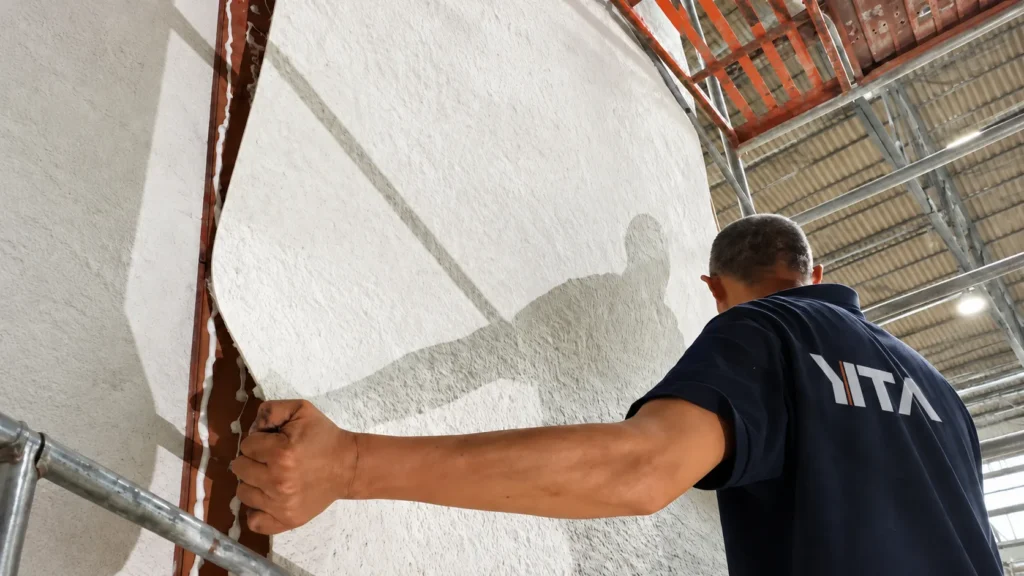
The way the adhesive is applied matters as well.
If only small areas of the panel make contact with the wall while larger sections remain unsupported, the risk of hollow areas increases. Poorly treated edges and joints may also allow water to enter and affect the bonding layer over time.
For renovation projects, we prefer to resolve substrate problems before installing the new finish.
Repairing an unstable wall first is usually much easier than investigating blistering or detachment after the facade is complete.
Lightweight Does Not Mean Bonding Can Be Ignored
Depending on the texture, YITA flexible stone typically weighs around 3.5–9.7 kg/m².
Compared with traditional thick stone systems, the lower weight reduces additional load on the wall and can make handling, installation and renovation more flexible.
But lightweight does not mean bonding becomes less important.
Even a light panel can fail if it is installed over a loose, damp or unsuitable substrate.
Adhesive selection should be based on the substrate and the actual exposure conditions rather than on the idea of one “universal adhesive” for every project.
During installation, consistent contact between the back of the panel and the substrate matters more than simply applying more adhesive. Spot bonding and large unsupported areas should be avoided.
Check the wall first, then decide on the bonding system.
For a real project, that is usually more useful than asking which adhesive is “best” in isolation.
Can Flexible Stone Be Used on Curved Walls?
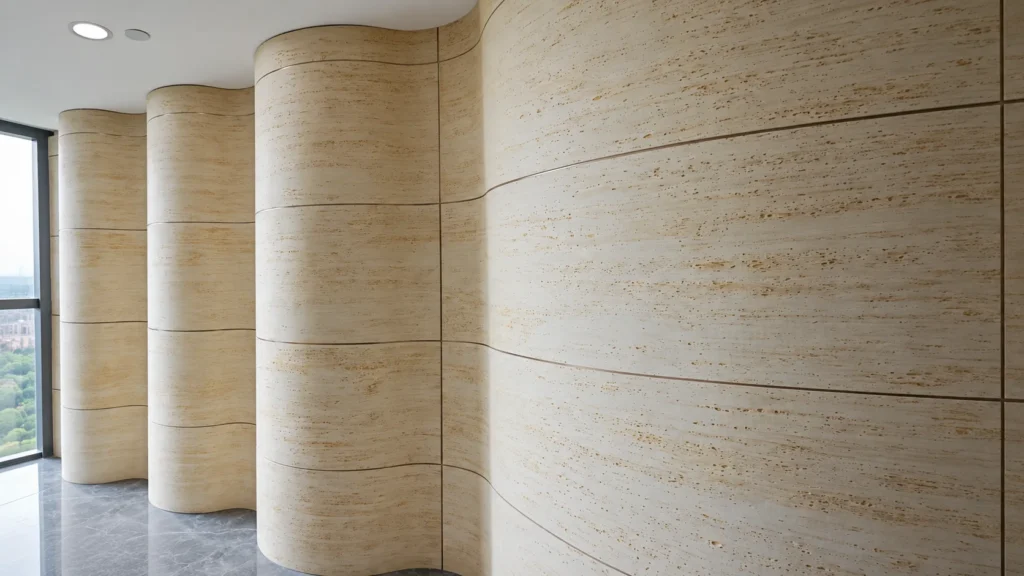
Yes, but it depends on the texture.
The name “flexible stone” can sometimes give the impression that every product bends to the same degree.
That is not the case.
A relatively flat, thinner travertine texture will usually adapt more easily to columns or gentle curves. Deeper textures with more pronounced surface relief generally have a more limited bending range.
If a project includes curved surfaces, we do not recommend judging flexibility from product photos or from the term “Flexible Stone” alone.
A more reliable approach is to test the actual sample being considered for the project on a curve close to the intended radius.
Check both the face and the edges after bending.
If cracking or obvious distortion appears, the curve is too tight for that particular texture.
So even within the same flexible stone category, different finishes still need to be assessed individually.
Joints and Corners Matter More Than They Seem
On an exterior wall, joints are not only part of the visual layout.
They also affect installation, movement and water management.
In a typical installation, joints of around 6–8 mm may be used, but the final width should still be determined by panel size, facade design, project conditions and local construction requirements.
Window openings, parapets, outside corners and the bottom edge of a wall also deserve particular attention because these areas are often more vulnerable to water entry than large flat wall surfaces.
A 45-degree edge detail, for example, can create a clean-looking outside corner, but a visually neat corner is not automatically a reliable weatherproof detail.
Appearance and protection need to be considered together.
Is Flexible Stone Waterproof?
It is important to separate two different questions:
How much water does the material absorb?
and
Is the complete exterior wall waterproof?
According to our product data reports, flexible stone has a water absorption rate of 7.5%.
The tested specimens showed no blistering, cracking, delamination or chalking.
This describes the material itself. It does not mean that a completed flexible stone facade can replace the building’s waterproofing system.
A real exterior wall also includes joints, windows, flashings, waterproofing layers, drainage paths and other construction details.
If an existing wall already has a water-ingress problem, adding a decorative finish to the surface will not correct deficiencies in the building envelope.
A more accurate way to understand the material is:
Flexible stone is an exterior decorative finish, not the building’s waterproofing layer.
How Are Fire Performance and Project Certifications Handled?
Fire performance should be based on actual testing and certification rather than broad marketing claims.
YITA flexible stone products are classified as A1 under GB 8624-2012.
However, fire standards, test methods and documentation requirements vary between countries and regions.
For each order, we review the specific product being purchased together with the fire-safety requirements of the destination market and confirm which standards or certifications are required.
Where additional testing or certification is needed, we arrange the relevant tests for the actual product being supplied and provide the corresponding reports or certificates with the order.
This means the customer receives documentation that relates to the product they are actually buying and the requirements of their project, rather than a generic certificate with no direct connection to the supplied material.
What Do We Check Before Recommending Flexible Stone for an Exterior Project?
Before recommending a specific product or installation approach, we normally review:
- project country and local climate
- facade orientation and exposure to sun and rain
- new construction or renovation
- condition of the existing wall and substrate
- selected texture, size and thickness
- bonding method
- joints, corners and window details
- drainage and waterproofing design
- curved walls or other special conditions
- required test standards and certification documents
If the project includes unusual curves, complex corners or non-standard substrates, it is often useful to confirm the application with samples or a small mock-up before placing the final order.
Sometimes a real sample on site tells us more than the word “flexible” in a product catalogue.
So, Can Flexible Stone Be Used Outdoors?
Yes.
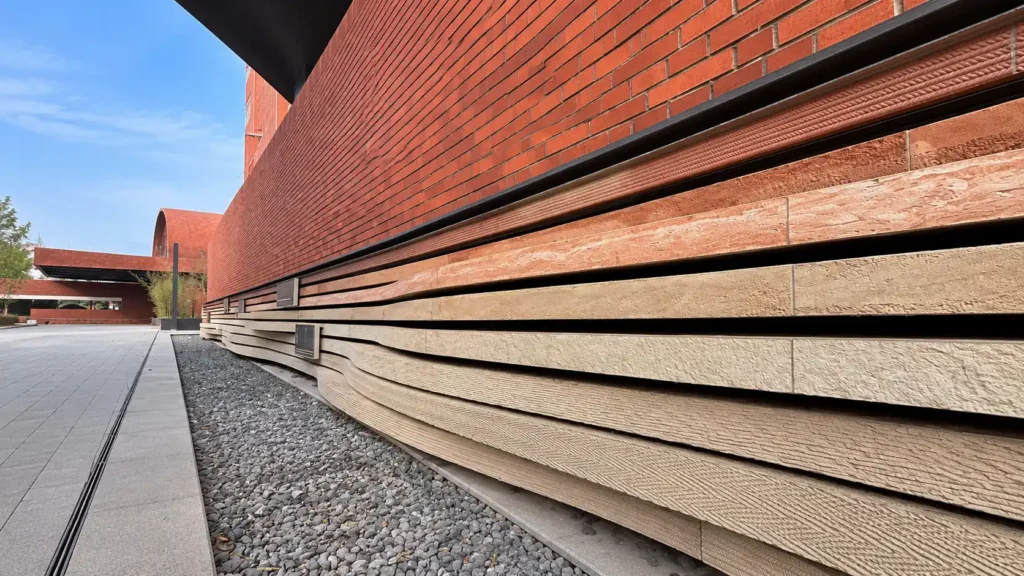
For the right project, flexible stone can provide a lightweight, thin exterior finish with a wide range of stone and mineral textures.
It can be particularly useful where the project needs to limit additional wall load or where renovation work should add as little thickness as possible.
Whether the material is truly suitable still comes back to the building itself.
If you are considering flexible stone for an exterior wall, send us the project location, drawings, existing wall condition and the textures you are interested in.
We can then review the actual project conditions and recommend suitable products, installation methods, and any testing or certification documents that may be required.